Dig Deeper

I recently read a profile of writer Pat Conroy and his wife, Cassandra King, also a novelist. I can’t remember his exact words, but in the article, Pat stresses the importance of “digging deeper” when he reaches an impasse in his writing. The answer is there, but he must dig deeper within himself to find it.

As an itinerant gardener, I found this advice to be very useful. My efforts are mostly confined to container gardening—quick payoff for minimal effort—but I’ve always admired the true gardeners, those who know what they’re doing. They’re willing to invest the time to make sure the soil is properly prepared. They, too, “dig deeply” to tender the loving care necessary to yield maximum blooms.

It’s the same way with writing. When I’m struggling, I can drift off the page for “research” but the truth is that most solutions are within my reach if I think carefully enough. Curiously, some of the best solutions happen when I’m not writing. They happen when I’m gardening, cooking, or walking the dog. Or, they can also arise during time spent with other writers.

Yesterday, I had the privilege of attending a workshop hosted by the Burlington Writer’s Club in Graham. Young adult writer Maureen Wartski, novelist and teacher, led a group of us on revision. From description to flashback, we spent time on the little tricks that writers use to propel their stories. At the end, she encouraged us all to created detailed outlines—much in the way that a gardener might create a landscape blueprint—to help guide our stories. The more I think about it, the more I realize how much writers and gardeners have in common. Gotta go…it’s time to prune my bushes!

Leaving A Trail

Last year I had the privilege of hearing Elizabeth Kostova, author of The Historian and The Swan Thieves, speak at the National Book Festival in D.C. about her personal writing process. She said that unlike some writers, she never plots too far ahead. Instead, she lets the story tell itself and trusts that all ends will fall into place eventually. While crouching on the grass in the heat, and trying not to worry about the camel cricket just inches away from me, I remember admiring her faith.

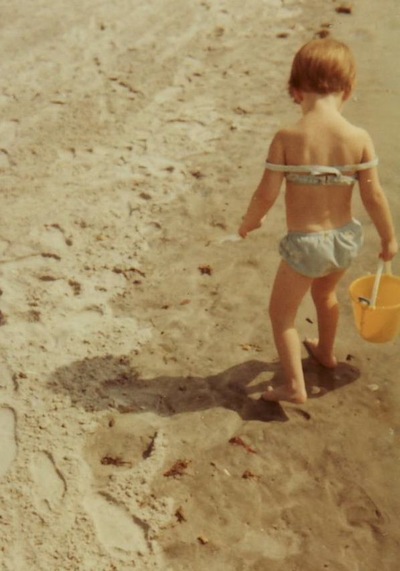
Just as this picture demonstrates, the trick for me is balancing my knowledge of the present moment with the trail I’ve got to leave behind me. It’s not easy to remember to plant nuance and clues for the reader. For the fiction writer can leave very little to chance.   If you drag a toe in the sand, there needs to be a reverse action that makes sense for the reader.

Now at work on my second novel, and thoroughly enjoying the new characters and complications introduced into the familiar town of Yatesville, I still work from a rough outline. It’s at the top of my file and serves as a guidepost of where I hope to end up. Not sure that’s the best way but it works for me. It’s like my little yellow bucket of shells. It’s a catch-all for the tidbits I can’t bear to leave behind.

Fiction As Social Discipline

The magnificent novel, The Imperfectionists, by debut author Tom Rachman, is a treasure trove of humanity. It is a book to be read over and over again. From loneliness to heartbreak, the author lays bare the universal emotions that unite us all. And yet, at its conclusion, I chanced upon another delight. In the back of the book, the author is interviewed by none other than Malcolm Gladwell, one of my favorite philosopher/authors.

Not only does this interview deliver great insights into the novel, but Malcolm, known for his nonfiction books, The Tipping Point and Blink among others, shares his insights on fiction:

“In a good book, we get an intimate and nuanced picture of someone–to the point where our own prejudices are completely displaced by the world created by the author. That’s an extraordinarily important kind of social discipline: It reminds us that an important part of what it means to be human is to replace our snap judgments about people with the empirical evidence they offer us.”

Va-va-voom! Upon reading this, I felt my heart swell with happiness. Malcolm had just articulated one of the many reasons that fiction appeals to so many of us. In this multi-tasking, technology-driven world, reading fiction takes on a new urgency. It’s not just leisure anymore, as Malcolm asserts, it’s social discipline. I’ll take that one step further: reading fiction is our duty!

St. Francis De Sales, Where Have You Been?

Dear St. Francis:

I must confess that I first learned of your existence just this past week, when my muse and fellow writer reminded me of the Catholic tradition of saints.

“A patron saint of writers? Come on,” I said in disbelief.

“There’s a saint for everything!” Melissa declared.

Thanks to Google (which, by the way, shares its first letters with your boss), we found your story immediately. So I ask, dear St. Francis, where have you been all my life?

Hearing about your difficulties made me feel much better about my own drudgery, which is nothing compared to your mission, I should say. But if you can write thousands of leaflets by hand and deliver them through miles of snow with bleeding feet, surely I can finish my second novel.

Your appearance this week brought blessings all around. For just two days after we found you, Melissa learned that her first essay (a literary tour-de-force, by the way) was accepted by a professional journal. St. Francis, please accept our heartfelt thanks for your role in this victory, and as we all have other such belles-lettres in submission purgatory, please do us a favor and give those pieces a similar nudge toward publication heaven.

Saying a prayer right now…


Who’s Driving the Car?

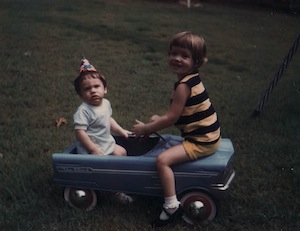
Lately, as I trudge through my second novel, I’ve found that my secondary characters are trying to hijack the story. As my little brother once discovered, one day you can be pedaling along in your brand new car, and next thing you know, big sis jumps onboard!

So what do you do? How do you put the wheel back into the hands of the main character?

First off, recognize that those minor characters need to have a voice. Why else would they be hammering so loudly in your head? Second, give them that voice by devoting some space to their back stories and motivations. Will you be able to use it all? Maybe not  yet. Putting it down on paper might just satisfy those pesky little voices. And hold on to what you write, because one day, those supporting characters could become the “stars” of another book. It certainly wouldn’t be the first time!

Finding Your Point of View

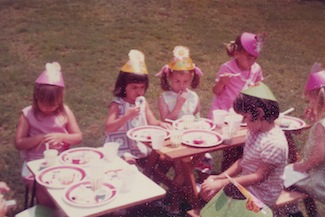
What is the daisy-capped girl in the pigtails thinking? Mumm….frosting. How about the little brunette in the pixie cut? Is that a bee over there?

While the occasion of my five-year-old birthday party has long slipped from memory, I share this old polaroid to demonstrate the virtues of multiple points of view. It’s very clear that each one of the celebrants has her own thoughts. A novelist seeking to bring the story to life has several options.

Skip the cake. I want to open presents. (First person).

You are hot, hungry, and tired, but you are determined to enjoy yourself. (Second person).

The mothers hovered round their little darlings, wanting to freeze that moment in time. The birthday girl was the happiest she had ever remembered but in two short hours she would be put in the corner for bickering with her brother. (Third person omniscient.)

When I finally settled on writing a novel, I knew I’d have to tackle the tricky question of point of view. It is central to a novel because it drives the characters, the plot, and the story. At first I was anxious. Maybe I’d do something easy, like first person. Most modern novels (Straight Man by Richard Russo) use first person. First person may seem easy, but it’s not.  Think Huckleberry Finn. Second person was above my comfort level. Third person omniscient, still used today, was very popular in the last century, with epic novels such as Anna Karenina or Portrait of a Lady.

Because Naked and Hungry is a mystery, I eventually chose a variation of third person omniscient, one with multiple points of view. This allowed me to share bits and pieces not known to H.T., the main character.  It allows the reader the luxury of being in on a secret, which is always fun. I also appreciated the ability to change gears. Moving from carefree H.T. to hypocritical Myrtle kept me from getting bored. Moreover, introducing a fresh point of view is surprisingly useful in controlling the tempo of a novel. Just finished a fast-paced scene wrought with danger? Your reader will thank you by following with a more light-hearted episode.

Unlike the traditional third person omniscient, I avoid sweeping generalizations and drifting in and out of my characters’ heads. Don’t get me wrong. I have nothing against this point of view. The truth is that I’m a little intimidated. Who can compete with the narrator’s breezy yet lyrical description of Gatsby’s famous parties? In his blue gardens men and girls came and went like moths among the whisperings and the champagne and the stars. Enough said.

Were the girls at my summer party thinking of champagne or stars? Probably not, but my friends and I were certain to have dreams of our own. A kitten? A slip-n-slide? It could have been as simple as a party favor. When experimenting with point of view, why not pull out an old photo for inspiration? You’re certain to get much more than a point of view. You might just get a story.

Fiction or Nonfiction?

Fiction or nonfiction, which do you prefer? Like many writers, I enjoy reading and writing both. But if you had to choose one or the other, which one would you pick?

Perhaps it’s a silly thing to debate. My 90-year-old grandfather and I recently had a mini-debate over the best kind of berry. Although he grudgingly admitted that his favorite is the blackberry, he didn’t defend his choice with much passion. Why, he finally asked me, do I have to choose?

The fiction vs. nonfiction debate is one that my dear friend Melissa and I often enjoy, mostly for academic purposes. We know we don’t really have to choose but the competitor in each of us loves drawing the battle lines and defending our positions.

For me, it’s easy. I’ll take fiction any day. Why? While nonfiction can be absorbing, especially if done well, (like my friends at SMITHSONIAN or dear Malcolm Gladwell) can you really lose yourself in these pieces the same way that you can a novel such as 1984 or Great Expectations? The best nonfiction writers employ fictive devices (the narrative, the flashback, the climax) to draw the reader in. And for good reason. They work.

The fiction writer, similarly, steals from the real world. She recreates her own version of a Manhattan neighborhood that is modeled from life. She may give a character a signature expression that she borrowed from a real person. And certainly, if she needs to describe the fragrance of a peach, she would do her readers a disservice if she had never actually picked up a fresh one and inhaled from its fuzzy flesh.

What’s the difference then? Why is the experience of fiction for some more enjoyable than that of nonfiction? For me at least, I find the experience of being transported into an author’s private world — his emotions, his sense of place and his story — utterly irresistible. Best of all, I know that there’s something larger at work. I know that there will be a resolution of some sort. It may not be the happiest of endings (think again of 1984 or Great Expectations) but thanks to the author, the loose ends will be wrapped up in some way. As the reader, I will be treated to a resolution.

Real life, on the other hand, is full of ragged edges. As much as I’d like to think otherwise, the longer I live, the more I suspect that some things don’t happen for a reason. A straight newspaper article about a bank robbery, while interesting, doesn’t capture my imagination the same way that a novel about the same subject might. A novel about a bank robbery would build to that climax slowly, perhaps explaining the motivations of the robber. It might even describe the same situation from the point of view of the victim. And the author would be bound by his honor to pull these details together in a way that rewards the reader.

I adore nonfiction for the same reasons Melissa does: its sharp detail and its immediacy. She is also a photographer (no surprises there) and one of the most efficient collectors and retrievers of facts that I know. In a word, she is brilliant, and I jokingly call her Me-Google, or my own personal Google. Facts are useful, no doubt, but aren’t they best enjoyed when interwoven into a story of one’s own?

Another friend named Kelly and I once studied Buddhist meditation for a few weeks. We made it almost to the end of the course, but my interest gave out when the teacher insisted that while meditating we focus on the “experience” of our day rather than the “story.”  But the story, my version of events and how I will tell it to others, is far more dear to me than any experience. Even today, I can’t remember the details of our defection, but in my mind, Kelly and I slipped out of the darkened room and drove to Bojangles where we spent the next hour drinking sweet tea and laughing. Our “story” ended up being more memorable than the “experience” of sitting cross-legged trying to clear our minds.

The debate will go on between me and Melissa, and I look forward to more spirited discussions on the matter. But for me, first there’s fiction. And everything else will always be nonfiction.


The Big Cover Up

Yesterday I went shopping with my mom. We ended up at Belk’s in Burlington. There I overheard the most fascinating conversation between a bride-to-be and a make-up artist. The bride was at her wit’s end in preparing for the big day. She had a rather generous splash of freckles and sadly, was intent on covering them up at any cost. Every time I walked by, the make-up artist had applied yet another coat of concealer or a new kind of makeup. It was all to no avail. In the end, both bride and artist fortunately agreed that covering up those freckles would have given her skin a thick and overly-made-up appearance. She was better off letting her natural beauty shine. I’m not sure about the bride’s frame of mind as she walked away, but I can only hope she did so accepting herself the way she is.

Since then, I couldn’t help thinking about the attempt that we all make to hide our flaws, whether through cosmetics, conversation, or some other kind of subterfuge. Naturally, there’s interesting implications for every fiction writer. Just how much do you reveal about your character’s flaws? Especially in the beginning, as your reader is just getting to know him or her. We all remember that age-old adage  of “show, rather than tell” but how just much do you show?

I’m currently working on the first act of my second novel, tentatively titled: “Born Again, Dead Again.” The first act should be the easiest part, right? You’re still in the first flush of a new story, and have a bevy of new characters to introduce. Actually, it’s quite challenging. The hard part is trying to figure out how much of the character’s back story to reveal in the first few chapters. Reveal too much, and you lose your reader. Reveal too little, and you risk the same thing. It’s kind of like making a new friend. How much do you reveal about yourself in the beginning? How much do you hold back?

There’s no clear answer, that’s the mystery of human relations. For the fiction writer, the one who holds the reins of the story, there can be a lot of editing involved. In my case, it’s pulling out some of the back story and saving it for later. Sooner or later, those freckles will resurface. And curiously, it’s those freckles, the so-called flaws, that actually give your story texture and dimension.

Spending time with old and new friends in Asheboro

Writing is a solitary business. Not necessarily a lonely business but by definition one that requires you to spend immense amounts of time inside your own cranium. This private time is vital but it’s just as important to spend time in the outside world. Social interaction adds variety to your writing and reminds you of why you write in the first place: to connect with and learn from other people.

This morning I had the pleasure of spending time with about 30 delightful members of the Asheboro Rotary Club. An old friend and progressive leader of Asheboro had asked me to speak to the members about my adventures in fiction writing and website development. This is one of my favorite topics, and it’s always a pleasure to talk about things you love with such a friendly, bright and well-informed audience. We discussed the difference between an internet presence and a true-web-based business, and I shared some secrets behind my own site, World of Crepes, which now receives more than 700 daily unique visitors.

As promised, here is a version of my presentation to the Asheboro Rotarians: Putting Your Passion to Work: How to Build a Profitable and High-Traffic Website.

Several of the members asked about the possibility of expanding my presentation, and I’m happy to report that these plans are in the works. I hope to offer a longer version of today’s talk as a half-day workshop that gives practical advice on how anyone can create a dynamic and high-traffic website with little to no knowledge of technology. Stay posted to my blog for dates and times in the near future.

I ask a favor today. It’s actually a fun exercise that may help you crack the mystery of your own special expertise area. As you go about your life, ask yourself:

  • What am I an expert in?
  • What do people routinely ask my advice about?
  • What would I like to be an expert in?
  • What subject do I love so much that I’m willing to spend just 1-3 hours per week writing about or researching?

This last question is key. But beware, your answer may lead you on an exciting journey to a place you haven’t yet imagined.

A Little Menace

Got writer’s block? Don’t try to conquer it on your own. Find a little menace.

“I think a little menace is fine to have in a story. For one thing, it’s good for the circulation. There has to be tension, a sense that something is imminent, that certain things are in relentless motion, or else, most often, there simply won’t be a story.” — Raymond Carver. On Writing. 1981.

The legendary short story writer Raymond Carver held Flannery O’Connor in such high esteem that it’s easy to imagine he was thinking of her most famous story when he penned these words. Here he outlines the perfect recipe for a rich and satisfying story, and the fiction writer would do well to study this advice within the context of “A Good Man Is Hard to Find.” While a violent criminal known as “The Misfit” does emerge, this classic story is driven by the “menace” of the protagonist. The scheming grandmother delivers the conflict, the motion, and the tension.

A first lesson for any beginning writer is to recognize the importance of conflict to a story. This one provides a textbook example of how to establish it quickly and effectively. In fact, in what other story is the conflict so quickly laid bare? With the very first sentence, “The grandmother did not want to go to Florida,” the stage is set. Although she is unsuccessful in changing the destination of the family vacation, she does manage to control the motion by engineering a detour.

In an attempt to relive her youth, she baits the children into convincing their father to take them off the main highway in search of a mysterious plantation house with secret hiding places. By the time she remembers that the house is actually located in Tennessee, the cat she had stowed in a basket suddenly springs forth and causes the wreck that delivers them directly into the path of the Misfit. Their doom is sealed by her arrogance. Her desire for supremacy overrules any sense of caution for as soon as she knows who he is, she immediately confronts him. “You’re the Misfit!” she says. The Misfit’s reaction is calm but ominous: “It would have been better for all of you, lady, if you hadn’t of reckernized me.”

The menace is also responsible for simmering tensions in the form of family dysfunction, which heightens the conflict in the story. The grandmother is a master of manipulation, and her weak son is easy prey. Bailey has many opportunities to stand up to her but fails. In the end, once they are at the mercy of the Misfit, he tries unsuccessfully to take charge but finds himself immobile. “ ‘Hush! Everybody shut up and let me handle this!’ He was squatting in the position of a runner about to sprint forward but he didn’t move.” To the end, even as he is pulled into the woods to be shot, he acknowledges his mother’s hold over him. “I’ll be back in a minute, Mamma, wait on me!”

Either tyranny skips a generation in this family or June Star and Wesley are simply emulating their grandmother but nonetheless these two are despots in miniature. They are more than disrespectful to their elders; they use aggression—both verbal and physical—to have their way: “John Wesley kicked the back of the front seat and June Star hung over her mother’s shoulder and whined desperately into her ear that they never had any fun even on their vacation, that they could never do what THEY wanted to do.” In spite of their obnoxiousness, however, they are nothing more than their grandmother’s pawns. She knows precisely how to rally them to her cause. “ ‘There was a secret panel in this house,’ she said craftily, not telling the truth but wishing that she were, ‘and the story went that all the family silver was hidden in it when Sherman came through but it was never found . . .’ ”

The story reaches its climax when the grandmother locks horns with the Misfit, and the story’s most meaningful showdown ensues. Here she has met her match. While she continues to employ manipulation as her weapon, there is a new desperation. Helpless against the physical power of the tall Misfit, his henchmen, and their guns, the grandmother’s superiority dissolves into obsequiousness: “You’ve got good blood! I know you wouldn’t shoot a lady! I know you come from nice people!”

The two do forge a bond of some sort, and the Misfit unburdens his heart. He apologizes for his lack of a shirt and divulges details about his upbringing and his supposed injustices. The tension escalates as the members of the grandmother’s family are shot, one by one, and in a futile attempt to save herself, the menace turns evangelist. “If you would pray,” she says, “Jesus would help you.”

Their conversation ends abruptly when she goes too far and hits a nerve. “She saw the man’s face twisted close to her own as if he were going to cry and she murmured, ‘Why you’re one of my babies. You’re one of my own children!’ The Misfit sprang back as if a snake had bitten him and shot her three times through the chest.”

Even though she has to die in this story, the grandmother and the Misfit appear to have an enduring impact on one another. She may indeed have found salvation, as indicated by her smiling dead face and he, by acknowledging his own distaste for his crimes, does confess to owning a conscience of some sort. The story’s most famous line reinforces her murderer’s role as redeemer: “ ‘She would of been a good woman,’ The Misfit said, ‘if it had been somebody there to shoot her every minute of her life.’ ”

Much has been written about religious symbolism and the question of grace in “A Good Man is Hard to Find,” but for the student seeking to understand the more basic elements of a story, he or she can learn volumes about conflict by studying the role of the grandmother. Such characters can propel the conflict, tension and even the plot of a story. The menace may be annoying, despicable or even downright evil, but such a character is never dull. And their appearance is sure to help you solve even the most stubborn case of writer’s block.