Naked and Hungry Goes to Greensboro!

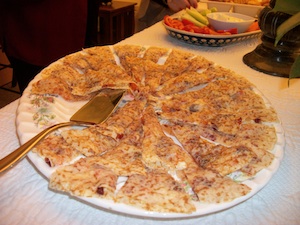
Just returned from the 10th Annual Celebration of Farmers at the Greensboro Farmers’ Curb Market, a surprisingly extensive local market founded in 1874, which makes it one of the state’s oldest. The market offers a variety of seasonal produce, home-baked goods and even crafts, such as jewelry and crocheted hand-towels.

My good friend Donna Myers from high school organized this event, which offered a delicious country breakfast on red-checkered table cloths and live music. I recommend the biscuits and homemade strawberry jam! All total, there were more than 100 attendees, some of the friendliest people I’ve ever met. These included tobacco and corn farmers, members of a Peruvian friendship mission, even Presbyterian minister-song writers. A highlight was my friend Cosmo pictured to the left showing off his new trick. Paws up to Naked and Hungry!

A special thanks to Donna for inviting me, and to Claudia and Charlie Griffin for their hospitality and cheerful help setting up the Naked and Hungry tent. Couldn’t have done it without you! Also, thank you Yolanda and Emma for making the trek from Durham to hear the reading. Wish I’d gotten your picture!
For more pictures, check out our Greensboro Farmers’ Curb Market album.

Dig Deeper

I recently read a profile of writer Pat Conroy and his wife, Cassandra King, also a novelist. I can’t remember his exact words, but in the article, Pat stresses the importance of “digging deeper” when he reaches an impasse in his writing. The answer is there, but he must dig deeper within himself to find it.

As an itinerant gardener, I found this advice to be very useful. My efforts are mostly confined to container gardening—quick payoff for minimal effort—but I’ve always admired the true gardeners, those who know what they’re doing. They’re willing to invest the time to make sure the soil is properly prepared. They, too, “dig deeply” to tender the loving care necessary to yield maximum blooms.

It’s the same way with writing. When I’m struggling, I can drift off the page for “research” but the truth is that most solutions are within my reach if I think carefully enough. Curiously, some of the best solutions happen when I’m not writing. They happen when I’m gardening, cooking, or walking the dog. Or, they can also arise during time spent with other writers.

Yesterday, I had the privilege of attending a workshop hosted by the Burlington Writer’s Club in Graham. Young adult writer Maureen Wartski, novelist and teacher, led a group of us on revision. From description to flashback, we spent time on the little tricks that writers use to propel their stories. At the end, she encouraged us all to created detailed outlines—much in the way that a gardener might create a landscape blueprint—to help guide our stories. The more I think about it, the more I realize how much writers and gardeners have in common. Gotta go…it’s time to prune my bushes!

Leaving A Trail

Last year I had the privilege of hearing Elizabeth Kostova, author of The Historian and The Swan Thieves, speak at the National Book Festival in D.C. about her personal writing process. She said that unlike some writers, she never plots too far ahead. Instead, she lets the story tell itself and trusts that all ends will fall into place eventually. While crouching on the grass in the heat, and trying not to worry about the camel cricket just inches away from me, I remember admiring her faith.

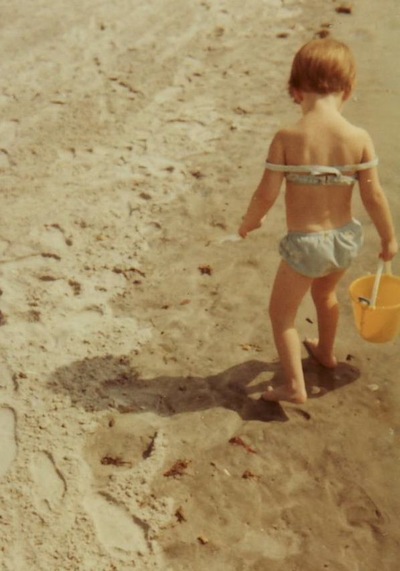
Just as this picture demonstrates, the trick for me is balancing my knowledge of the present moment with the trail I’ve got to leave behind me. It’s not easy to remember to plant nuance and clues for the reader. For the fiction writer can leave very little to chance.   If you drag a toe in the sand, there needs to be a reverse action that makes sense for the reader.

Now at work on my second novel, and thoroughly enjoying the new characters and complications introduced into the familiar town of Yatesville, I still work from a rough outline. It’s at the top of my file and serves as a guidepost of where I hope to end up. Not sure that’s the best way but it works for me. It’s like my little yellow bucket of shells. It’s a catch-all for the tidbits I can’t bear to leave behind.

Fiction As Social Discipline

The magnificent novel, The Imperfectionists, by debut author Tom Rachman, is a treasure trove of humanity. It is a book to be read over and over again. From loneliness to heartbreak, the author lays bare the universal emotions that unite us all. And yet, at its conclusion, I chanced upon another delight. In the back of the book, the author is interviewed by none other than Malcolm Gladwell, one of my favorite philosopher/authors.

Not only does this interview deliver great insights into the novel, but Malcolm, known for his nonfiction books, The Tipping Point and Blink among others, shares his insights on fiction:

“In a good book, we get an intimate and nuanced picture of someone–to the point where our own prejudices are completely displaced by the world created by the author. That’s an extraordinarily important kind of social discipline: It reminds us that an important part of what it means to be human is to replace our snap judgments about people with the empirical evidence they offer us.”

Va-va-voom! Upon reading this, I felt my heart swell with happiness. Malcolm had just articulated one of the many reasons that fiction appeals to so many of us. In this multi-tasking, technology-driven world, reading fiction takes on a new urgency. It’s not just leisure anymore, as Malcolm asserts, it’s social discipline. I’ll take that one step further: reading fiction is our duty!

Finding Your Point of View

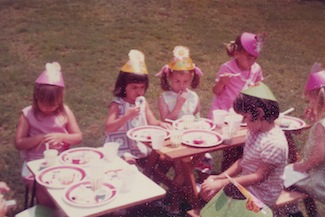
What is the daisy-capped girl in the pigtails thinking? Mumm….frosting. How about the little brunette in the pixie cut? Is that a bee over there?

While the occasion of my five-year-old birthday party has long slipped from memory, I share this old polaroid to demonstrate the virtues of multiple points of view. It’s very clear that each one of the celebrants has her own thoughts. A novelist seeking to bring the story to life has several options.

Skip the cake. I want to open presents. (First person).

You are hot, hungry, and tired, but you are determined to enjoy yourself. (Second person).

The mothers hovered round their little darlings, wanting to freeze that moment in time. The birthday girl was the happiest she had ever remembered but in two short hours she would be put in the corner for bickering with her brother. (Third person omniscient.)

When I finally settled on writing a novel, I knew I’d have to tackle the tricky question of point of view. It is central to a novel because it drives the characters, the plot, and the story. At first I was anxious. Maybe I’d do something easy, like first person. Most modern novels (Straight Man by Richard Russo) use first person. First person may seem easy, but it’s not.  Think Huckleberry Finn. Second person was above my comfort level. Third person omniscient, still used today, was very popular in the last century, with epic novels such as Anna Karenina or Portrait of a Lady.

Because Naked and Hungry is a mystery, I eventually chose a variation of third person omniscient, one with multiple points of view. This allowed me to share bits and pieces not known to H.T., the main character.  It allows the reader the luxury of being in on a secret, which is always fun. I also appreciated the ability to change gears. Moving from carefree H.T. to hypocritical Myrtle kept me from getting bored. Moreover, introducing a fresh point of view is surprisingly useful in controlling the tempo of a novel. Just finished a fast-paced scene wrought with danger? Your reader will thank you by following with a more light-hearted episode.

Unlike the traditional third person omniscient, I avoid sweeping generalizations and drifting in and out of my characters’ heads. Don’t get me wrong. I have nothing against this point of view. The truth is that I’m a little intimidated. Who can compete with the narrator’s breezy yet lyrical description of Gatsby’s famous parties? In his blue gardens men and girls came and went like moths among the whisperings and the champagne and the stars. Enough said.

Were the girls at my summer party thinking of champagne or stars? Probably not, but my friends and I were certain to have dreams of our own. A kitten? A slip-n-slide? It could have been as simple as a party favor. When experimenting with point of view, why not pull out an old photo for inspiration? You’re certain to get much more than a point of view. You might just get a story.

Fiction or Nonfiction?

Fiction or nonfiction, which do you prefer? Like many writers, I enjoy reading and writing both. But if you had to choose one or the other, which one would you pick?

Perhaps it’s a silly thing to debate. My 90-year-old grandfather and I recently had a mini-debate over the best kind of berry. Although he grudgingly admitted that his favorite is the blackberry, he didn’t defend his choice with much passion. Why, he finally asked me, do I have to choose?

The fiction vs. nonfiction debate is one that my dear friend Melissa and I often enjoy, mostly for academic purposes. We know we don’t really have to choose but the competitor in each of us loves drawing the battle lines and defending our positions.

For me, it’s easy. I’ll take fiction any day. Why? While nonfiction can be absorbing, especially if done well, (like my friends at SMITHSONIAN or dear Malcolm Gladwell) can you really lose yourself in these pieces the same way that you can a novel such as 1984 or Great Expectations? The best nonfiction writers employ fictive devices (the narrative, the flashback, the climax) to draw the reader in. And for good reason. They work.

The fiction writer, similarly, steals from the real world. She recreates her own version of a Manhattan neighborhood that is modeled from life. She may give a character a signature expression that she borrowed from a real person. And certainly, if she needs to describe the fragrance of a peach, she would do her readers a disservice if she had never actually picked up a fresh one and inhaled from its fuzzy flesh.

What’s the difference then? Why is the experience of fiction for some more enjoyable than that of nonfiction? For me at least, I find the experience of being transported into an author’s private world — his emotions, his sense of place and his story — utterly irresistible. Best of all, I know that there’s something larger at work. I know that there will be a resolution of some sort. It may not be the happiest of endings (think again of 1984 or Great Expectations) but thanks to the author, the loose ends will be wrapped up in some way. As the reader, I will be treated to a resolution.

Real life, on the other hand, is full of ragged edges. As much as I’d like to think otherwise, the longer I live, the more I suspect that some things don’t happen for a reason. A straight newspaper article about a bank robbery, while interesting, doesn’t capture my imagination the same way that a novel about the same subject might. A novel about a bank robbery would build to that climax slowly, perhaps explaining the motivations of the robber. It might even describe the same situation from the point of view of the victim. And the author would be bound by his honor to pull these details together in a way that rewards the reader.

I adore nonfiction for the same reasons Melissa does: its sharp detail and its immediacy. She is also a photographer (no surprises there) and one of the most efficient collectors and retrievers of facts that I know. In a word, she is brilliant, and I jokingly call her Me-Google, or my own personal Google. Facts are useful, no doubt, but aren’t they best enjoyed when interwoven into a story of one’s own?

Another friend named Kelly and I once studied Buddhist meditation for a few weeks. We made it almost to the end of the course, but my interest gave out when the teacher insisted that while meditating we focus on the “experience” of our day rather than the “story.”  But the story, my version of events and how I will tell it to others, is far more dear to me than any experience. Even today, I can’t remember the details of our defection, but in my mind, Kelly and I slipped out of the darkened room and drove to Bojangles where we spent the next hour drinking sweet tea and laughing. Our “story” ended up being more memorable than the “experience” of sitting cross-legged trying to clear our minds.

The debate will go on between me and Melissa, and I look forward to more spirited discussions on the matter. But for me, first there’s fiction. And everything else will always be nonfiction.