Book Club + Crepes = Good Times!

Last Thursday I had the honor of speaking to about two dozen members of a book club (a day time group and a nighttime group) in the lovely neighborhood of Chapel Ridge in Pittsboro. I was invited by a dear lady named Beti Ann, with whom I share another good friend and hairstylist, Tonya. In fact, it was through Tonya that the invitation came about, for she has been plugging my book for almost a year to all of her patrons!
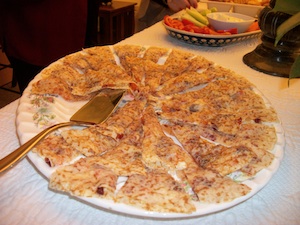
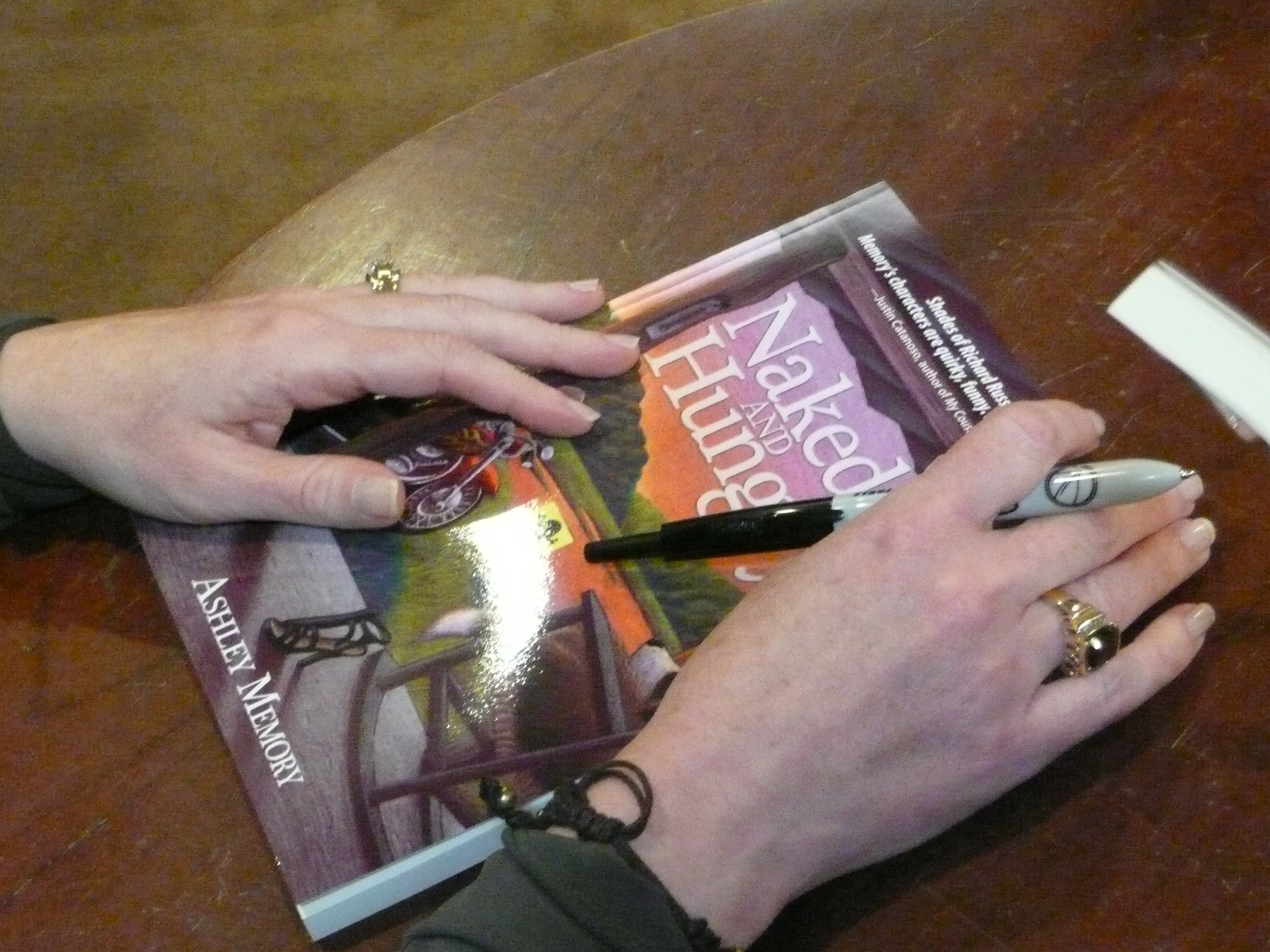
Not only did the group serve delicious appetizer crepes (cream cheese with sweet-hot jelly), it was a joy to learn that many of them had already read Naked and Hungry. This led to an insightful discussion about not just the book, but the writing process, which is a favorite topic among book clubs. My heartfelt thanks to Beti Ann, Mary, Sherry, Katherine, Cary, Julie and all the new friends I made.

This is the second book club I have spoken to, third if you count a long-distance relationship with a club in Florida that is dear to my heart. In fact it was the Happy Bookers of Lakeland, Fla., that inspired the creation of a special Naked and Hungry Q & A just for book clubs. And my first book club appearance was arranged through another childhood friend from my hometown of Asheboro.

Lesson learned? For all of my writer friends, as you seek connections with local book clubs, don’t rule out your childhood friends and especially your hairstylist! As for the latter, not only does she or he know all your secrets, they also know everyone else’s!

Easy Reading is Damn Hard Writing…

The title of this post came from American author Nathaniel Hawthorne, in what I’m sure was one of a random sequence of quotes from Mother WordPress meant to inspire us bloggers. The timing turned out to be serendipitous because these words magically appeared in the same week that I’m diving into the revision of Born Again, Dead Again.

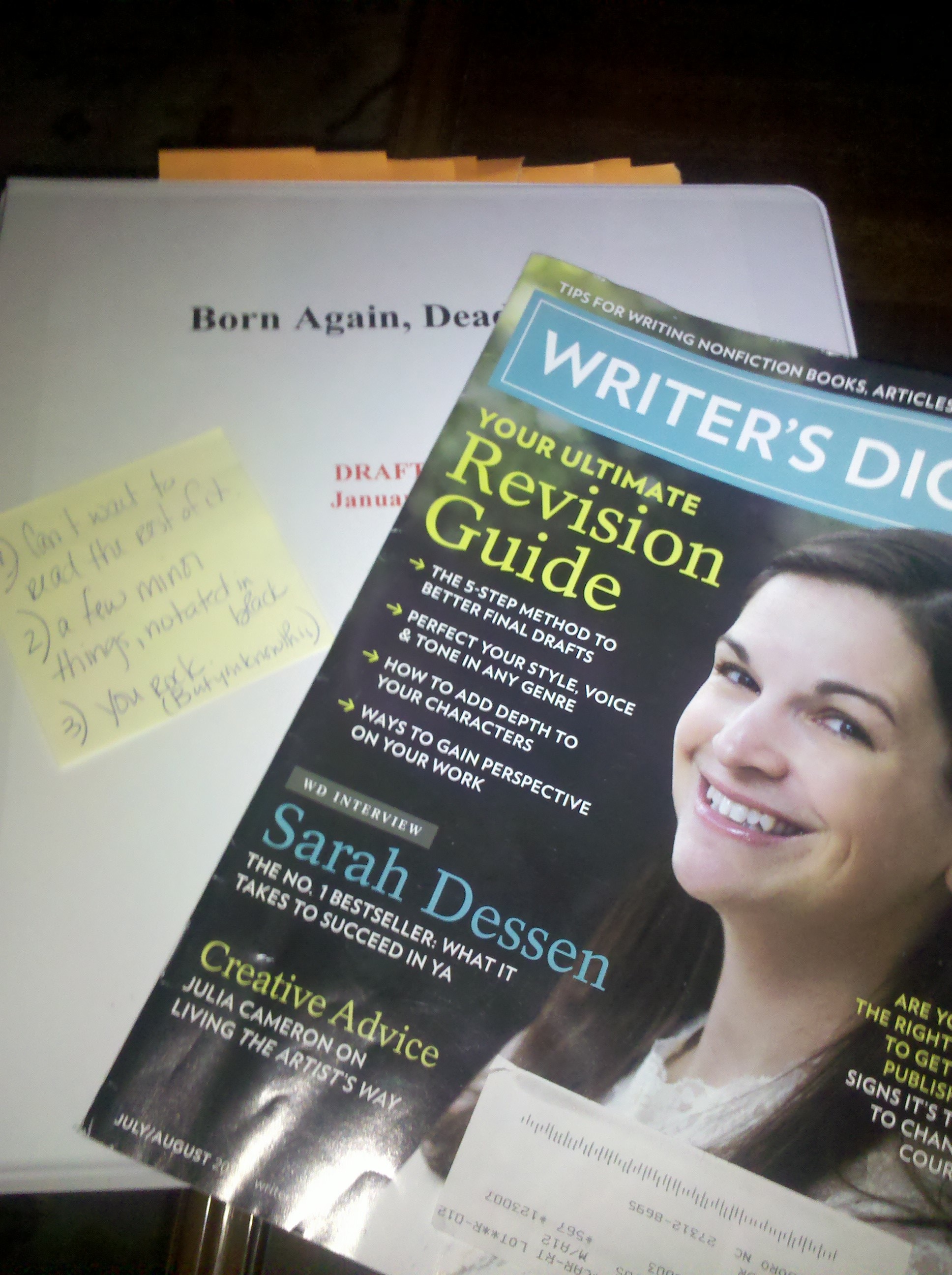
As you can see from the flagged copy of my most recent version, much work still lies ahead. The good news is that childhood friend and muse Tonya (the orange tags) and fellow writer and colleague Melissa (yellow tags) have generously contributed their time and energy into a careful review of the book to-date. Another thanks goes to a more recent muse who kindly reviewed Julio’s Spanish for me (¡Hay Dios mio!). All of this feedback is balanced with the gentle counsel of my editor and friend, Judy Geary, whose belief in my work and these characters has been my compass throughout.

Back to Nathaniel’s words. It is indeed amazing how hard the writing process can be, even for those of us who adore it. I can’t tell you how many hours have been spent on a single paragraph, and the number of revisions that a single sentence has endured.

I will say that a recent ally has been an old article in Writer’s Digest (above) by James Scott Bell on the subject of revision. There are many gems in “The Geyser Approach to Revision,” but most notably the following: “In shaping your manuscript…embrace the ebb and flow of a revision process that maximizes both creative surges and quiet analysis.” As many of you know, I have always prided myself on the ability to separate my writer self from the critical reader. I insisted that this was necessary. However, I’m beginning to rethink this belief, thanks to Bell. He reminds us that during revision, you don’t have to deprive yourself of the creativity that inspired you to write in the first place.

Bell’s advice has been liberating and frankly, a bit joyous. Don’t be afraid to overwrite, he says, deepen those details, and draw upon the evocative power of music. These words have helped tremendously, especially when sifting through the comments my friends have so generously contributed. And to Tonya, Melissa, Judy and other friends, I will again concur with the words of Hawthorne. As he said of his own friend’s advice: “I care more for your good opinion than for that of a host of critics.”

Cheers!


Naked and Hungry Hits the Road in 2012!

Thanks to the support of fans like you, Naked and Hungry had a great year in 2011, with invitations to speak at two bookstores, three Rotary clubs, Spa at Bell House, Coffee and Crepes, The State of Things, and the crowning event, being the guest of the Happy Bookers Club at the Asheboro Library last month.

We’re excited to announce that we’ve got an exciting line-up for Spring 2012, as Naked and Hungry hits the road again, with stops in Pittsboro, Colfax, Asheboro, and Cary.

If any of these events are near you, I hope that you’ll find the time to attend. As always, I’ll be reading from the book, discussing the joys of fiction….and giving away a crepe pan from Williams-Sonoma!

The highlights are listed below, but there is much more to come (including area bookstores), so please stay tuned to the Events Calendar throughout 2012. All events are free and open to the public.

Thursday, January 26 at 7 p.m. – Chapel Ridge Book Club, Chapel Ridge Community Center, Pittsboro, NC

Tuesday, February 21  at 7 p.m – River Landing Retirement Community, Colfax, N.C.

Thursday, March 22 at 7 p.m.- Friends of the Library Adult Program, Asheboro Public Library at 7.p.m.

Wednesday, March 28  at 7 p.m – Glenaire Retirement Community, Cary, N.C.

Hope to see you soon!


Mopping My Way into 2012


I may be the only person who celebrated New Year’s Eve by mopping her kitchen floor but boy, was it cathartic! You see, after one and a half years, Born Again, Dead Again is finally finished. Of course, much proofreading lies ahead but I’ve done the hardest part, tying up the loose ends and resolving the plot to my satisfaction.

And after several days spent curled up with my laptop, it felt great to stretch my legs again. That made me look around the house and see all the work that I’ve neglected for the past few days…but first I think I’ll treat myself to a coconut martini, a bowl of popcorn and a re-run or two of Strangers with Candy (my guilty pleasure).

I suppose I should set new resolutions for 2012, but having finished this book (a 2011 resolution by the way), I’m okay playing it by ear for a change.

We do have a number of events ahead next year for Naked and Hungry, so I hope to see you in 2012. For now, here’s wishing you a productive year and a few quiet moments to celebrate the accomplishments of 2011.

Advice to a Poet…and All the Writers Out There

A friend of mine recently asked that I share some advice with a friend of his, who happens to be an emerging poet seeking publication. It’s always a pleasure to connect with other writers, so I decided to post my response here, in case that my journey might help someone else.

Dear Poet:

As much as I love poetry, I am a novelist so I’m afraid I don’t have the kind of specific advice that an experienced poet might offer, but I can tell you what I might do if I were you. So please take this with more than a grain of salt.

Because of the explosion of the internet (a market of 2-billion+ users) and the need for quality content, short stories and poetry are very much in demand, so yes, you should continue to pursue publication in online publications. And if you haven’t already, I would definitely enter my work into contests. This is a way for your work to attract attention and to develop a following. It also helps you develop early credentials for your work. Naked and Hungry did not win the 2009 James Jones First Novel Fellowship, but it was one of 7 finalists in a field of 653. So I included this note in all query letters and eventually added it to the bio section of my published book. More valuable than a cash prize? You bet!

Next, if you haven’t already, I would purchase a copy of The Writer’s Market. Pronto! There’s a specific edition available just for poets and other genres such as children’s books, for example. This is the best way to get a bead on all the available markets for poetry and contests.  It also provides guidance on the development of a query letter, which is essential for approaching agents and publishers. This book is how I found my publisher, Ingalls Publishing Group, which specializes in regional and N.C. writers.

Also, you should strongly consider joining a writer’s group, in person or online. It’s a great way to get honest feedback on your work and trade ideas on publication opportunities. And again, you will have an instant “fan base” when you are published. Writers have a long tradition of supporting each other, and I am so fortunate that at least a handful will show up at my readings. They will also write reviews for you, an action that is absolutely immeasurable.

And finally, as you probably know, the publishing industry is undergoing radical changes, with the advent of e-books and the tragic closure of so many bookstores. Printing is an expensive business, which is why the big name publishers rarely take on new writers. However, the upside is that there is more opportunity for the little guys, at least those who are willing to work at it and pursue new markets for their work. Self-publishing should be strongly considered, especially for those writers with an entrepreneurial instinct. If you believe in your work, I would probably explore the idea of self publishing a small book of it and offering it for sale on Amazon. It would be an interesting experience and well worth the exploration, especially if you are doing all you can to develop a following.

In conclusion, due in large part to all the changes in the publishing world, there is no clear-cut path to success. Every writer has their own journey and unique story to tell. It’s tempting to stress about how hard it is when you’re not a big name like John Grisham. But look at the flip side. Think about the freedom that comes with NOT being a big name like Grisham. Can you imagine what it would be like if your publisher had the authority to dictate to you what you should write? Or told you where you had to go and what you had to do to promote your work?

When times are tough, I always find comfort in the words of another writer, yes, a poet, the legendary Maya Angelou. She once wrote:

“The world owes you nothing. Accept that and you are truly free.”

Believe in yourself, blaze your own trail, and have fun!


Calling all Type A’s!

Are you a Type A person? Trying to do too much? If you’re like Margaret Freeman, the office manager of McMullen Quality Pre-Owned Automobiles and one of the main characters in Naked and Hungry, you may be on STRESS OVERLOAD!

To be fair, poor Margaret suffers from stress on all sides. For an example, read this exchange between Margaret and H.T.

“You’re late again,” said Margaret. “And why can’t you just once dress up for work?”

“What’s wrong with my T-shirt?” asked H.T. “Is it the saying you object to?”

“ ‘I refuse to have a battle of wits with an unarmed opponent.’ C’mon H.T., some people might take that as an insult.”

“Not our customers. They want one just like it., ” says H.T. “Hey, where’s Julio?”

“Out back, where else? You know he’s been like a man possessed, working on that Chevy. We’ve got other vehicles we need to fix up, H.T. In fact, we’ve had at least two people stop to ask about that Bobcat, but you know as well as I do that its engine needs to be rebuilt.”

For fun, and in celebration of our upcoming reading at Spa at Bell House on August 19, take a moment to participate in our trivia contest and identify the  major stress factor in Margaret’s life.

Tune in next time for the answer, the recommended Spa Bell House treatment for Margaret, and more details. In the meantime, RSVP for the event and make plans to join us on Friday, August 19. We’ll be reading a section from the book, giving away a special prize, but most importantly, enjoying some great food and conversation in the company of friends. Now that’s the ultimate stress-buster!

Leaving A Trail

Last year I had the privilege of hearing Elizabeth Kostova, author of The Historian and The Swan Thieves, speak at the National Book Festival in D.C. about her personal writing process. She said that unlike some writers, she never plots too far ahead. Instead, she lets the story tell itself and trusts that all ends will fall into place eventually. While crouching on the grass in the heat, and trying not to worry about the camel cricket just inches away from me, I remember admiring her faith.

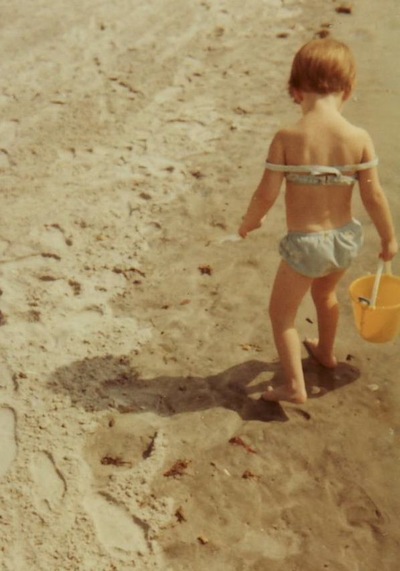
Just as this picture demonstrates, the trick for me is balancing my knowledge of the present moment with the trail I’ve got to leave behind me. It’s not easy to remember to plant nuance and clues for the reader. For the fiction writer can leave very little to chance.   If you drag a toe in the sand, there needs to be a reverse action that makes sense for the reader.

Now at work on my second novel, and thoroughly enjoying the new characters and complications introduced into the familiar town of Yatesville, I still work from a rough outline. It’s at the top of my file and serves as a guidepost of where I hope to end up. Not sure that’s the best way but it works for me. It’s like my little yellow bucket of shells. It’s a catch-all for the tidbits I can’t bear to leave behind.

Finding Your Point of View

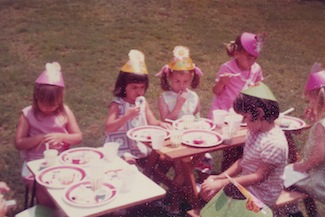
What is the daisy-capped girl in the pigtails thinking? Mumm….frosting. How about the little brunette in the pixie cut? Is that a bee over there?

While the occasion of my five-year-old birthday party has long slipped from memory, I share this old polaroid to demonstrate the virtues of multiple points of view. It’s very clear that each one of the celebrants has her own thoughts. A novelist seeking to bring the story to life has several options.

Skip the cake. I want to open presents. (First person).

You are hot, hungry, and tired, but you are determined to enjoy yourself. (Second person).

The mothers hovered round their little darlings, wanting to freeze that moment in time. The birthday girl was the happiest she had ever remembered but in two short hours she would be put in the corner for bickering with her brother. (Third person omniscient.)

When I finally settled on writing a novel, I knew I’d have to tackle the tricky question of point of view. It is central to a novel because it drives the characters, the plot, and the story. At first I was anxious. Maybe I’d do something easy, like first person. Most modern novels (Straight Man by Richard Russo) use first person. First person may seem easy, but it’s not.  Think Huckleberry Finn. Second person was above my comfort level. Third person omniscient, still used today, was very popular in the last century, with epic novels such as Anna Karenina or Portrait of a Lady.

Because Naked and Hungry is a mystery, I eventually chose a variation of third person omniscient, one with multiple points of view. This allowed me to share bits and pieces not known to H.T., the main character.  It allows the reader the luxury of being in on a secret, which is always fun. I also appreciated the ability to change gears. Moving from carefree H.T. to hypocritical Myrtle kept me from getting bored. Moreover, introducing a fresh point of view is surprisingly useful in controlling the tempo of a novel. Just finished a fast-paced scene wrought with danger? Your reader will thank you by following with a more light-hearted episode.

Unlike the traditional third person omniscient, I avoid sweeping generalizations and drifting in and out of my characters’ heads. Don’t get me wrong. I have nothing against this point of view. The truth is that I’m a little intimidated. Who can compete with the narrator’s breezy yet lyrical description of Gatsby’s famous parties? In his blue gardens men and girls came and went like moths among the whisperings and the champagne and the stars. Enough said.

Were the girls at my summer party thinking of champagne or stars? Probably not, but my friends and I were certain to have dreams of our own. A kitten? A slip-n-slide? It could have been as simple as a party favor. When experimenting with point of view, why not pull out an old photo for inspiration? You’re certain to get much more than a point of view. You might just get a story.

Fiction or Nonfiction?

Fiction or nonfiction, which do you prefer? Like many writers, I enjoy reading and writing both. But if you had to choose one or the other, which one would you pick?

Perhaps it’s a silly thing to debate. My 90-year-old grandfather and I recently had a mini-debate over the best kind of berry. Although he grudgingly admitted that his favorite is the blackberry, he didn’t defend his choice with much passion. Why, he finally asked me, do I have to choose?

The fiction vs. nonfiction debate is one that my dear friend Melissa and I often enjoy, mostly for academic purposes. We know we don’t really have to choose but the competitor in each of us loves drawing the battle lines and defending our positions.

For me, it’s easy. I’ll take fiction any day. Why? While nonfiction can be absorbing, especially if done well, (like my friends at SMITHSONIAN or dear Malcolm Gladwell) can you really lose yourself in these pieces the same way that you can a novel such as 1984 or Great Expectations? The best nonfiction writers employ fictive devices (the narrative, the flashback, the climax) to draw the reader in. And for good reason. They work.

The fiction writer, similarly, steals from the real world. She recreates her own version of a Manhattan neighborhood that is modeled from life. She may give a character a signature expression that she borrowed from a real person. And certainly, if she needs to describe the fragrance of a peach, she would do her readers a disservice if she had never actually picked up a fresh one and inhaled from its fuzzy flesh.

What’s the difference then? Why is the experience of fiction for some more enjoyable than that of nonfiction? For me at least, I find the experience of being transported into an author’s private world — his emotions, his sense of place and his story — utterly irresistible. Best of all, I know that there’s something larger at work. I know that there will be a resolution of some sort. It may not be the happiest of endings (think again of 1984 or Great Expectations) but thanks to the author, the loose ends will be wrapped up in some way. As the reader, I will be treated to a resolution.

Real life, on the other hand, is full of ragged edges. As much as I’d like to think otherwise, the longer I live, the more I suspect that some things don’t happen for a reason. A straight newspaper article about a bank robbery, while interesting, doesn’t capture my imagination the same way that a novel about the same subject might. A novel about a bank robbery would build to that climax slowly, perhaps explaining the motivations of the robber. It might even describe the same situation from the point of view of the victim. And the author would be bound by his honor to pull these details together in a way that rewards the reader.

I adore nonfiction for the same reasons Melissa does: its sharp detail and its immediacy. She is also a photographer (no surprises there) and one of the most efficient collectors and retrievers of facts that I know. In a word, she is brilliant, and I jokingly call her Me-Google, or my own personal Google. Facts are useful, no doubt, but aren’t they best enjoyed when interwoven into a story of one’s own?

Another friend named Kelly and I once studied Buddhist meditation for a few weeks. We made it almost to the end of the course, but my interest gave out when the teacher insisted that while meditating we focus on the “experience” of our day rather than the “story.”  But the story, my version of events and how I will tell it to others, is far more dear to me than any experience. Even today, I can’t remember the details of our defection, but in my mind, Kelly and I slipped out of the darkened room and drove to Bojangles where we spent the next hour drinking sweet tea and laughing. Our “story” ended up being more memorable than the “experience” of sitting cross-legged trying to clear our minds.

The debate will go on between me and Melissa, and I look forward to more spirited discussions on the matter. But for me, first there’s fiction. And everything else will always be nonfiction.