Flash fiction takes a direct shot

“Going at such a pace as I do, I must make the most direct shots at my object…no more pause than is needed to put my pen in the ink.” ~ Virginia Woolfclassroomshot
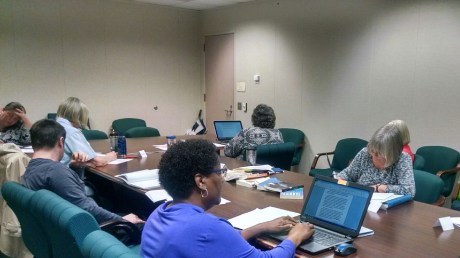
The above quote, shared at my Central Carolina Community College workshop last Saturday, does more than express the intensity of flash fiction; it also illustrates how quickly the time passed!

Our Flash Fiction Bootcamp II did indeed end far too quickly! In fact, we were still writing when the security guard at Central Carolina Community College came around and politely tapped her watch. But me and the seven devotees (eight if you count my trusty assistant, husband Johnpaul) of creative writing could have kept writing for hours….

We opened with an inspirational reading of Liz Wride’s terrific flash, Painted, published April 11 on Milk Candy Review.  For our first prompt, we riffed on her evocative first line (“They passed a law that everyone had to…..”) as a spark for our own stories. The results were both pithy and magical, ranging from “be kind to each other” or “own a Komodo dragon.” So much fun! Thank you Liz!

Other prompts included writing a flash from a favorite pet’s point of view and taking a cue from the Twilight Zone. One of our students shared a link to the opening narration so you can try this prompt on your own. We also played around with the French technique known as “N + 7″ which involves writing a couple of sentences and substituting nouns with every seventh you find in the dictionary after the original. This mode is particularly helpful when you find yourself stuck in a rut on a story. A new world can be just one word away.

The comments I received were far more than I deserved but very welcome, and the students kindly gave permission for their inclusion on this blog. “This was my first writing class,” said Mary T. “The encouragement received from Ashley was priceless and spurred me to write even more.”

“Ashley Memory is a great teacher – positive, affirming, inspiring. Love the quotes, writing tips, book recommendations.” Jeannie D’Aurora

And from Anne K., a veteran of the program, who is working toward her certificate in Creative Writing, a unique offering of the college:  “Ashley’s classes always provide a terrific combination of practical information, positive encouragement and hands-on experiences. She is both a talented teacher and writer and students get the benefit of both in her classes.”

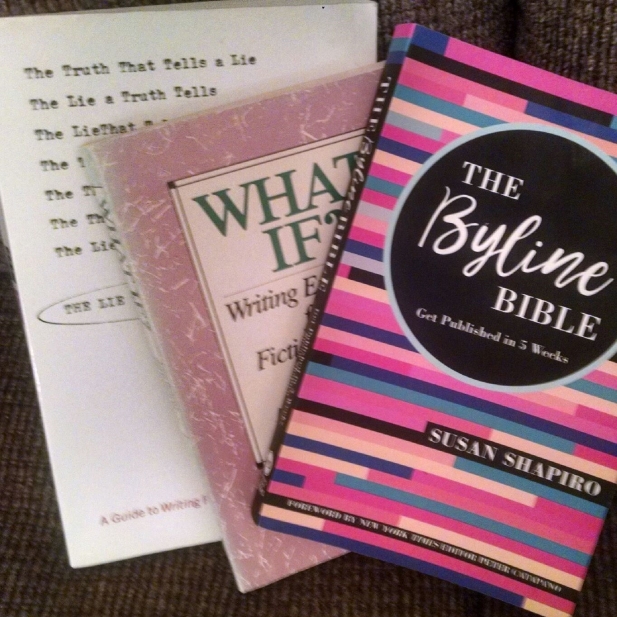
As a departure from the norm, for my next CCCC workshop, we’ll tackle a cousin of flash fiction. On Saturday, September 21, 2019 at 9 a.m., we’ll explore the exciting world of flash essays. We’ll also talk about ways to expand short memoir-style pieces into longer formats, taking cues from Susan Shapiro’s The Byline Bible.

Hope to see you in September, but in the meantime keep writing and delighting!


“Pfull” House at Pfeiffer and WOW!

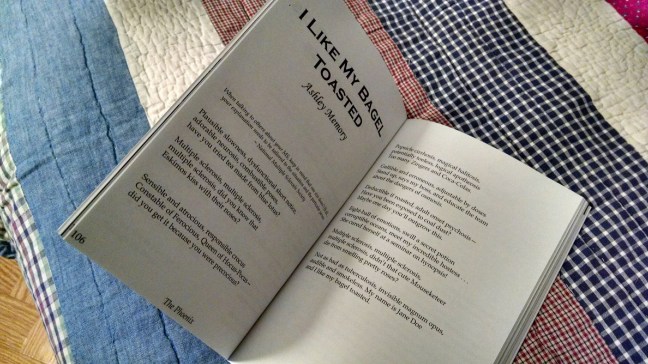
phoenix2Last night I had the pleasure of reading my poem “I Like My Bagel Toasted” at the special launch celebration of The Phoenix at Pfeiffer University, and it was a blast. First off, it’s a rarity to see more than 20 people at a literary event but at this wonderful occasion, there was at least 100–a “pfull” house by anybody’s standards! And anytime I get to see my friend Ruth Moose (and Pfeiffer alumna!) is always a special occasion.
Wonderful food, a great mixture of art (poems, stories, essays and photography!) and fabulous music made for an entertaining evening. The editors, staff, and advisors did a terrific job of making all attendees and authors feel appreciated.

bagelHats off to the editors who read and considered the nearly 1,000 submissions they received for this issue! My “bagel” and I were indeed lucky to be included. It’s taken a lot of courage to write about my multiple sclerosis so this has been a big step for me.
All in all, the day itself couldn’t have been more perfect. The weather alone was magnificent, sunny and dry with a gentle breeze. Amazing. And not only did my little bare-rooted Mara des Bois strawberry plants arrive from the nursery, I found out I won first place in the WOW Q2 Essay Contest for “How to Chop an Onion Without Crying.”

Isn’t it funny how life turns out? We writers work so hard, day in, day out, and the rewards are mostly internal–the joy you get from finding just the right word, putting your words to paper and sharing what you write with family and friends. But once in a while, the world surprises you with a little recognition and how sweet it is!

Wishing you strawberries, onions, bagels (and more) as you plow ahead and make your own writing dreams come true.


Flash Fiction Bootcamp II Coming Soon!

IMG_20190402_121354815_HDRIt’s snowing in the Uwharries today, on the second day of April no less! Big sloppy flakes drifting down like tiny snow angels. Or, according to my husband, who sees “Dick Tracy snowflakes with big black lines around them.”
 

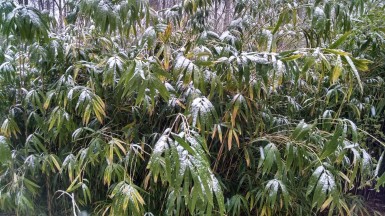
Whatever you see, these little bits of wintry precipitation (mixed with sleet) are a bit of a surprise this spring. They’re coating the surface of our bamboo like a dusting of confectioner’s sugar.  No yard work today after all. Instead, I’m dreaming ahead to Saturday, April 13, when I’ll lead round 2 of our Flash Fiction Bootcamp at Central Carolina Community College in Pittsboro.

I’m especially excited about this class because we’ll have a special guest! My son Dashiel, named for a writer himself (minus one “l” in the name) will be visiting from New York and sitting at the table with us. It will be fun to see what stories he conjures up, based on the singular experience of living in the “Big City.”

Our prompts this time will be brand new and guaranteed to fire your imagination. From writing from a dog’s (or cat, to be fair) point of view to using the innovative N + 7 French method of writing a couple of sentences and replacing every noun with the seventh in a dictionary, these story starters may just be the creative nudge you need for that latent story swimming around in your head. And as usual, I’ll also share a collection of my favorite litmags and contests so that those who wish to revise and see their work in print may pursue these avenues on their own.

For more information, and how to register, see below. In the meantime, cuddle up with a mug of hot chocolate, a good book, and a notebook of your own…..

Saturday, April 13 from 9.a.m – 3 p.m. – Flash Fiction Bootcamp II Workshop. Think you don’t have time to write? Anybody has time for flash fiction, and by the end of this workshop, you’ll have five finished stories. (This workshop is a continuation of the popular Flash Fiction Bootcamp I) but is open to new as well as returning students and features entirely new prompts and readings. Atten-hut! Central Carolina Community College Creative Writing Program in Pittsboro, N.C. Register here. or by calling (919) 545-8044.


Nudge the season with poetry!

As spring makes a tentative showing — with heavy rains and early leaves on the plum tree — it’s a perfect time to celebrate by writing. And what better way to nudge the new season than with a little poetry!

Interested? If so, I hope you’ll join me for a special weekday workshop at The Joyful Jewel in charming downtown Pittsboro on March 15.

Jump Start Your Poetic Inspiration on Friday, March 15 from 9:30 – 12:30.
You can find inspiration for poetry everywhere— from reading newspapers and periodicals to mining your daily life and memory. We’ll improvise on sample poems written by other poets and participate in wildly creative exercises meant to spark your own imagination. Not only will you end up with three new poems of your own, you’ll leave with a never-ending inventory of ideas that can be used for not just poetry but short stories, essays, and more. We might even pen a poem in time for the annual Vision and Voice celebration the very next month!

To register: Seats are limited so I encourage you to reserve your space today. To register, call The Joyful Jewel, 833-2775, 10:30am-5:30pm Monday through Saturday or Sunday 12pm-4pm. Cost: $50.

AM poster Jumpstart Your Poetic InspirationAbout me: I draw my inspiration from the ancient Uwharries of Randolph County, where I wake to the arpeggio of the pileated woodpecker. When I’m not musing on a metaphor, I’m either brewing raspberry jam or poking around an abandoned cemetery. My poetry and prose have recently appeared in Ginger Collect, Okay Donkey, Pinesong, Gyroscope Review, and Naugatuck River Review. New poems are forthcoming in Turnpike, The Phoenix and The Red Clay Review. My work has been nominated for a Pushcart Prize, and I’m a two-time recipient of the Doris Betts Fiction Prize.

How to End a Short Story

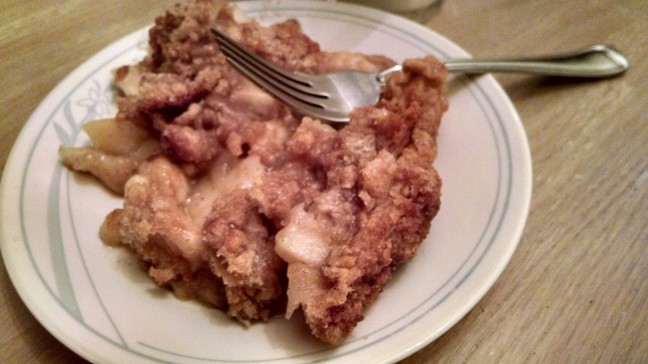
apple pie
The ending of a story should be like a slice of apple pie after a meal — giving the reader something to savor and remember long after the story concludes.

At the beginning of every new year, writers tend to think about beginnings–new resolutions, new inspiration and new directions. But as I started new work this month–particularly a story that recently bewildered me–I found myself struggling with endings.

Why are endings so hard? To help, I studied the final sentences of stories I admire.

“She walked up the stairs, tearing the note into tiny pieces that fluttered behind her like confetti.” Laurie Colwin, from “Children, Dogs, and Desperate Women.”

“I still seem to be holding that wisp of iridescence, not knowing exactly where to fit it, while she runs with her hoop ever faster around me and finally dissolves among the slender shadows cast on the graveled path by the interlaced arches of its low looped fence.” Vladimir Nabokov, “First Love.”

“But the pear tree was as lonely as ever and as full of flowers and as still.” Katherine Mansfield, “Bliss.”

“She sat for a while longer, then pulled the curtains back and the day came in. Hers was the ghost the night had brought, in her own image as she once had been.” William Trevor, “Sitting with the Dead.”

I also studied the words of some of my favorite writing teachers. Some say you should return to the beginning of your story and pick up a loose thread there to knot at the end. Others believe you should end on a strong image. John Dufresne, in his wonderful book The Lie That Tells A Truth says this is not the time to give us a moral or a message. “We only need the problem resolved.” And later: “End your story on your best, or second best, line. Don’t write past it. This is the line that echoes in our mind when the story is over.”

Anne Bernays and Pamela Painter, in their endlessly inspirational book What If, give a great exercise for endings. “Write one sentence for a story that is in its fourth or fifth draft. Then revise the story to heighten and illuminate this final meaning.”

As challenging as it can be, there is nothing like the inherent joy in writing stories–whether it’s that first sentence or even the title. And this makes the struggle worth it. Sometimes the very thing that’s holding us back IS the solution. One of my favorite philosophers, Marcus Aurelius, said it best: “The impediment to action advances the action. What stands in the way becomes the way.”

In my situation, it became very simple. The ending of my story troubled me because I hadn’t gotten the beginning or the middle right. So I had to backtrack a little bit. But when I followed the crumb trail of my original conception–what the story was REALLY about, I found my way home and then, and only then, resolved my story. And then I treated myself to a huge chunk of apple pie!

We’ll be doing a number of writing workshops very soon, where we’ll talk more about endings and everything in between. Stay tuned for the details, but in the meantime, I hope you’ll plan to join me in April for round two of our very popular flash fiction workshops.

Saturday, April 13 – Flash Fiction Boot Camp II Workshop. Central Carolina Community College Creative Writing Program in Pittsboro, N.C. Register here.

How to behave at a holiday party

Ever go to a pabeerty and feel like you don’t quite belong? Not sure about where to sit? Is that a cheese ball or a centerpiece? Is it edible? And what do you talk about when you find yourself balancing a glass of punch with strangers?
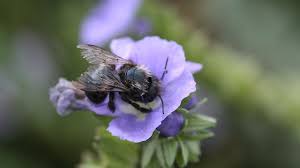
Now, imagine that you used to be a a blue orchard bee….a praying mantis….or even a monarch butterfly.  It’s even more befuddling.

“Holiday Party Etiquette for Insects Recently Transformed Into People,” a flash fiction up today at one of my favorite literary magazines, Okay Donkey, was inspired by my own shyness and angst at holiday parties. The story bloomed when I discovered a link on Reddit for a support group for former insects and an article on etiquette in Southern Living. I’m so honored that the donkey — himself a fan of “the odd, the off-kilter, and the just plain weird”– made a space for this little story.

Writers actually relish writing about things that make them feel uncomfortable. It’s cathartic and oddly, it can also be easier. Your emotions are already stirred up and accessible, ripe for the picking. For fun, try your hand at turning a real-life situation into speculative fiction. And if you were an insect, what kind would you be?


Bored? Write about it….

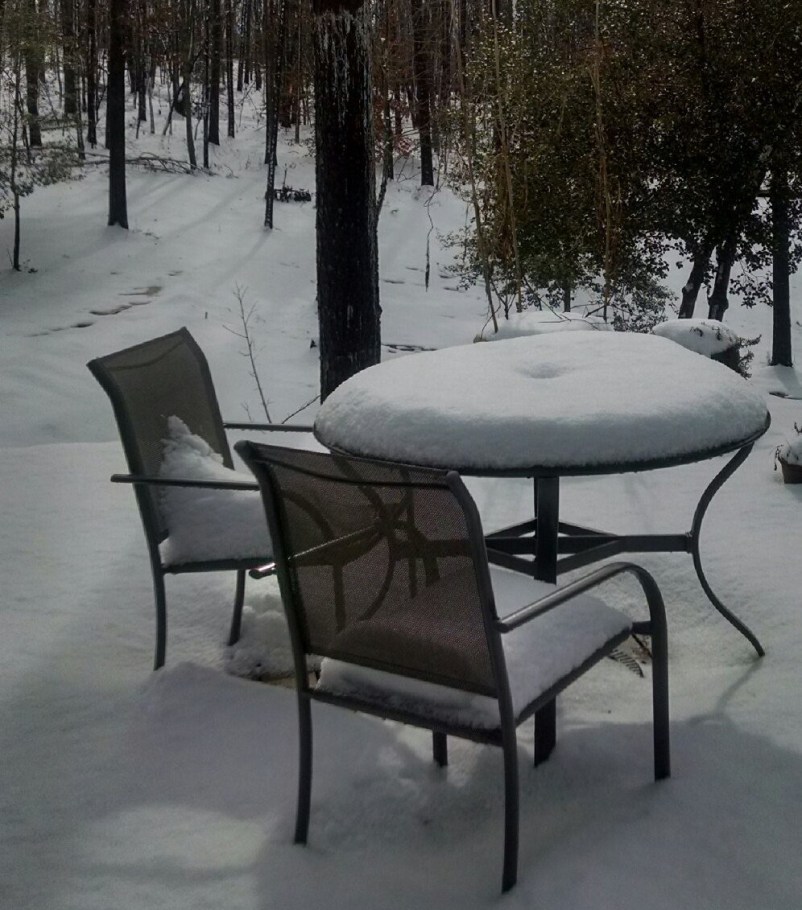
snow.jpgAs we recover from the early December snowfall, trapped at home due to icy roads, it’s easy to feel bored.
There are only so many ways you can reorganize your pantry and entertain house-bound dogs, and yes, even watching movies gets old pretty quickly. And reading, while always stimulating, feels self-indulgent to me after days on end.

I need to be writing! New material, not just editing. As good as it feels to whittle and sculpt, there’s no substitute to the high you get by rolling out new pearls. So, on to new stuff….

When writing creative nonfiction, it’s easy to be intimidated by all the great prose out there. I recently read essays by a woman visited by the ghost of her mother, an environmentalist who protests exploitation of sea life by robbing coastal souvenir shops with his father, and a piece by George Orwell about a wild elephant on the rampage in Burma. Do you ever feel that your own experience, while certainly special to you, seems inferior when stacked up against that of others?

Don’t! Just because you haven’t survived a harrowing incident recently, been the victim of a crime (thank goodness), or saved a baby from drowning, you still have an extraordinary life, and I promise, you can find something inspirational to write about.

And on that subject, one of my favorite prompts came from a Women on Writing  newsletter. It goes like this: “Take a small, boring moment that happened and write as much as you can about it. Go overboard describing it, and make this boring moment exciting by describing it in intense detail with ecstatic prose.”

So while we all might not have an earth-shattering event at our fingertips, we all do have a seemingly boring incident to write about AND possibly elevate. You just have to be creative about it. Such an assignment might also be fun — at the very least, it’s certainly good practice to flex those creative muscles and push yourself in this way.

Humm…reorganizing my pantry is suddenly exciting again. And didn’t one of the dogs do something silly this afternoon on a walk through the neighborhood….


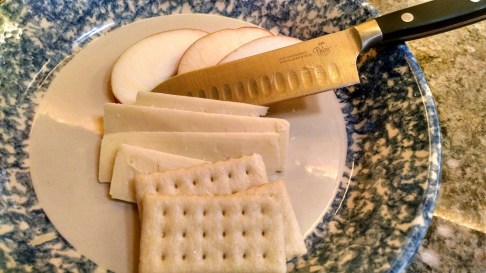
Treat your writing like fine cheese….

gruyere

It is a truth universally acknowledged that the best Gruyère cheese–the one earning the lofty “AOP” designation in Switzerland–merges both morning and evening milk.

The poet in me likes to think this means both the cow’s morning cheerfulness and her late afternoon pensiveness swirl into the same vat. It’s more likely that mixing last night’s milk into the morning batch gives a head start to the culturing process. The cheese is then aged five months up to a year, another step which lends Gruyère its trademark complexity–sweet, salty, and nutty.

William Trevor, one of my literary idols, was famous for penning a short story and putting it away for as much as six months before re-reading and revising. Now that takes discipline! It’s also a testament to his productivity. I’m sure he had so many pieces in various stages of production that it never bothered him to shelve something for a time.

Jane Austen is another writer known for her reflection. Pride and Prejudice took many years to write. And this delightful novel started out with the title of “First Impressions.” It was only after months of revision and consideration did she settle on the final name of the book that we all know and love so much today.

Both Trevor and Austen, although very different writers, made a name for themselves through complex characters and subtle humor, two elements that can only flourish with adequate rumination and revision.

The next time you finish a story, poem, or essay, try putting it away for a little while. At least give it a good night’s sleep. Fan those first flames of enthusiasm (morning milk) with a healthy dose of maturation (evening milk). I bet you’ll end up with a final product as nuanced and delicious as Gruyère! Bon Appétit!

Stuck in a rut? Try something new!

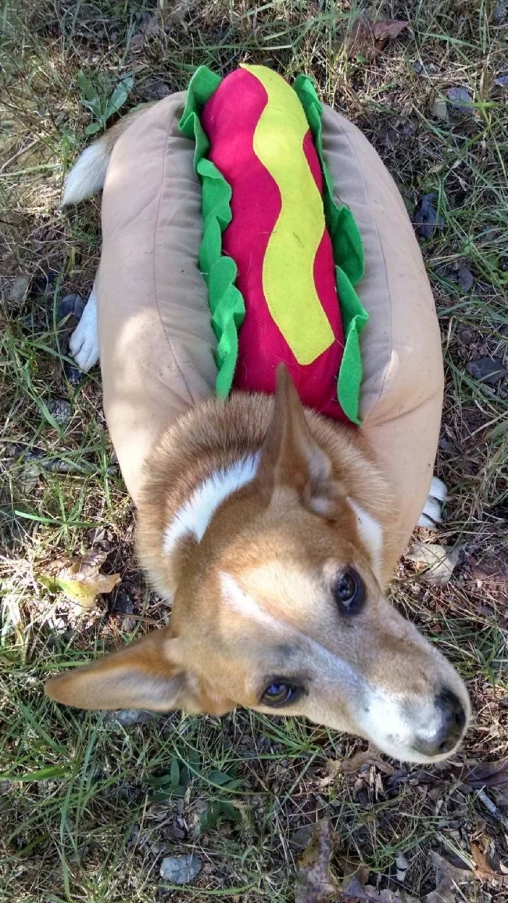
buster1.jpgFor Halloween, Buster, our little corgi-mix, decided to try a new look. Born with a hastily-tied white “Ascot” around his neck, he decided to switch things up this year. So he’s preening around in a hot dog bun. Hold the onions, please.
Buster’s transformation got me thinking about the myriad possibilities for writers. Are you stuck in a rut? Is your scarf askew? Sometimes, as we enter a new season–especially after a productive summer of writing–I start getting a little antsy. What’s next?

Like Chekhov, who loved wandering the cherry orchard, it helped me to go outside. On Whale Tail Road, we’re continuing to clean up brush and debris from two hurricanes. And Nature, as always, helped push me out of the rut. And it might help you too!

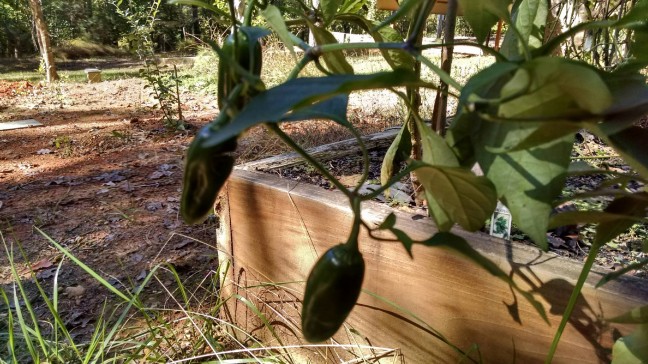
peppersOur jalapeno peppers truly hit their stride this fall, blessing us with a bountiful crop, even in October. So why not put a little kick in your own writing? When I think of the unexpected, Shirley Jackson always comes to mind. In her short story, The Daemon Lover, the protagonist takes the reader through a labyrinth of suspense. Does her mysterious fiancé exist at all? Can you take your reader on a similar journey? No need to veer into a thriller or horror (unless you want to!), you can actually do a lot by putting the familiar into a new context. Does the trip home, a short walk she has always taken, look a different to your protagonist today? Humm….
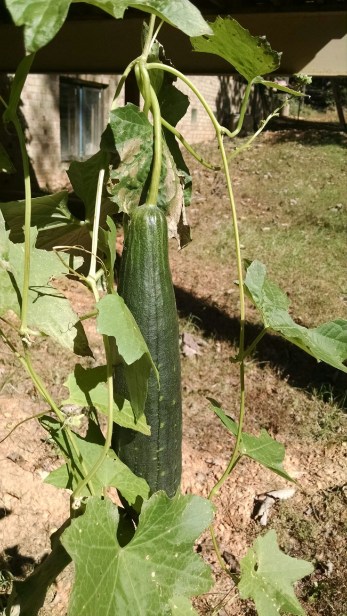
loofahGardening constantly surprises–with “volunteer” crops springing up in the most unexpected places. And this year, we had a volunteer loofah plant! When the seeds of last year’s crop fell through the deck, a new vine entwined its way up the retaining wall.

We’ve always loved loofah for its exfoliating qualities, so this, too, sent me on a detour. Like the loofah, all writers should feel free to “scrub off” the dead skin and start anew.

Can you give new life to a dead short story by turning it into a poem? And if that doesn’t work out, consider taking it back to a flash story, a shorter version of what you started with. I’ve had a lot of fun recently working on a short story of mine, “Lost and Found of the Dead,” which has turned into a poem, and then back into a story again.

Writing is the ultimate metamorphosis, when you think about it. What other profession allows you to “slip” into a costume and enter the mindset of someone else? No strings, no responsibilities, and it doesn’t cost a penny. So try something new this season and finish your 2018 writing year strong!

So from Buster and all of us at Whale Tail Road, Happy Halloween, er, make that Happy Transformation!